
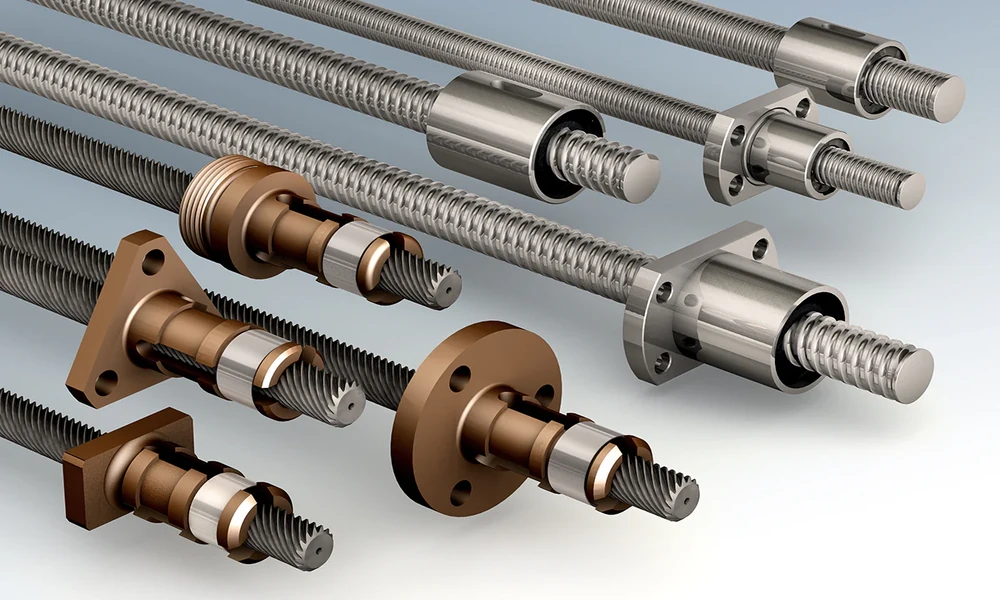
Designing machinery or automation systems often involves the critical challenge of cost management. Many engineers are accustomed to selecting ball screws as their default standard. However, for projects that do not require high operating speeds or micron-level precision, choosing over-specified components can unnecessarily drive up total project costs.
One practical alternative for projects with strict budget constraints is the Lead screw model DCM from THK. Let’s explore 5 engineering reasons why the lead screw Model DCM (In Thai known as ‘ลีดสกรู รุ่น DCM‘) serves as a cost-effective option for suitable applications.
1. Accessible Initial Cost
The structure of a lead screw is inherently simpler than that of a ball screw because it functions without ball bearings or complex internal recirculation mechanisms. This less complex manufacturing process keeps the price of lead screws at a much more accessible level. Consequently, it is an excellent choice for reducing initial project costs (Initial Cost), especially in small-scale projects or mass-produced machinery.
2. Self-Locking Potential in Specific Specifications
Lead screws rely on sliding friction to generate linear motion. For certain models with a low lead angle, they feature a mechanical characteristic known as “self-locking.” This inherent friction helps prevent the load from back-driving or sliding down under its own weight when the motor stops.
– Engineering Consideration: In specific vertical applications, this feature can potentially reduce the need for an additional electric or mechanical motor brake, helping optimize overall component costs. However, engineering calculations must always verify this property for each specific load before final implementation.
3. Dust and Contaminant Tolerance
In industrial environments filled with dust, debris, or manufacturing particles, ball screws can experience bearing failure or jamming if contaminants enter the internal raceways. Conversely, the Lead screw model DCM features a direct thread-to-thread contact structure with no intricate internal moving parts. This design provides a reasonable level of tolerance against dust and particles, effectively reducing the risk of sudden operational failure on the shop floor.
4. Manageable Maintenance Costs
Lacking micro-components and complex ball circuits, maintaining a lead screw is relatively straightforward. Furthermore, certain models are designed with advanced wear-resistant nut materials that can operate effectively with minimal lubrication. This allows users to plan and control maintenance costs efficiently while helping reduce unexpected machine downtime.
5. Quieter Operational Levels
If your machinery needs to operate in noise-sensitive environments-such as laboratories, medical facilities, or desktop 3D printing stations-lead screws are highly suitable. Since their mechanical motion relies on sliding contact rather than rolling metallic balls, they eliminate ball-bearing noise. This results in a noticeably quieter and smoother operational sound during linear translation.
Opting for a budget-friendly component does not mean you have to compromise on overall system quality. When engineers clearly understand application requirements, implementing the Lead screw model DCM in systems with moderate speed and accuracy thresholds can deliver excellent stability and cost-effectiveness.
If you are evaluating whether a new project is suitable for a lead screw configuration or looking to optimize machinery costs logically, consult the team at I.N.B. As an official THK distributor, we are ready to offer professional advice, assist with technical specifications, and deliver the right linear motion solutions that align with both your engineering criteria and your budget.